

Tree Talk Exhibition at the Gascoine Gallery
Talk of Trees Will Lure You to Monson
[Excerpted from Smaller shows at a trio of Maine galleries help usher in autumn]
September 1, 2024
Jorge S. Arango
TREE-HUGGING IN MONSON
As a sleepy town a little over two hours from Portland and cheek by jowl to the Appalachian Trail, Monson doesn't have the constant rotation of exhibits of a city. Two shows up right now are good examples: "Berenice Abbott's Greenwich Village" (at Monson Arts Gallery through Sept. 15), which features a portfolio of portraits and street scenes of the bohemian New York enclave by the famous photographer who lived the last years of her life in nearby Blanchard, and "Tree Talk" (which takes us right up to the end of 2024 on Dec. 31) at Monson Pottery/Gascoine Gallery.
The Abbott show and its backstory were featured in the Press Herald/Maine Sunday Telegram last month. The Monson Pottery/Gascoine Gallery show is, as the title indicates, all about trees and the myriad forms the subject takes, which is presented through multiple media, including painting, sculpture, photography, fiber art, book arts, ceramics and so on. It ranges from whimsical and fun to serious and physically imposing, giving us an enormous range of ways to look at and reconsider this essential – and, in the human mind, symbolic – element of nature.
Maine, according to the exhibition statement, is the most forested state in the union, and many people in the area make their living from trees in one way or another: making paper, crafting furniture, harvesting and selling wood, etc.
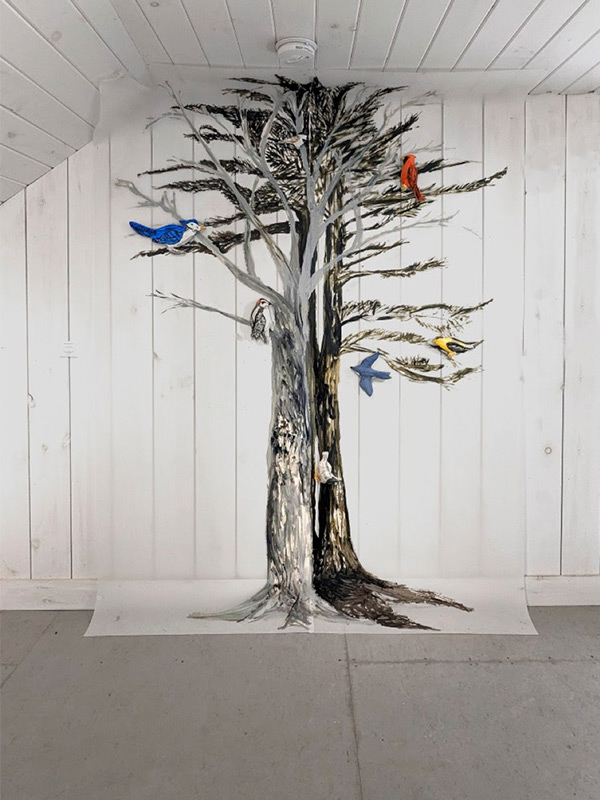
At the whimsical end are Barbara Sullivan's frescoes of birds, which she perched in a tree she painted against the wall at the top of the stairs. It is a charming piece, the fresco medium allowing her to represent various avian species in a colorful accessible way.
They can recall our childhood memories and depictions of jays, cardinals, woodpeckers, et alia. But it also reminds us of trees' role as vital habitats for the survival of all species.
Susie Brandt's colorful rip-stock banners of a tree stump also come off as cheery, mainly due to the bright color. But clearly this tree has been cut down, a jagged portion of it still protruding from the cleanly sawn surface.
Some works can feel slightly eerie, as with Todd Watts' "Copse Caper," a manipulated photo of a Hitchcockian flock of birds swarming through a stand of trees on a snowy winter night. Or there are Jonty Sale's surreal photo of a forest with what seems like another image of felled trees ghosted within it, and his "Animal Trees," in which he has digitally played with three images to create what looks like animal spirits living within the trees.
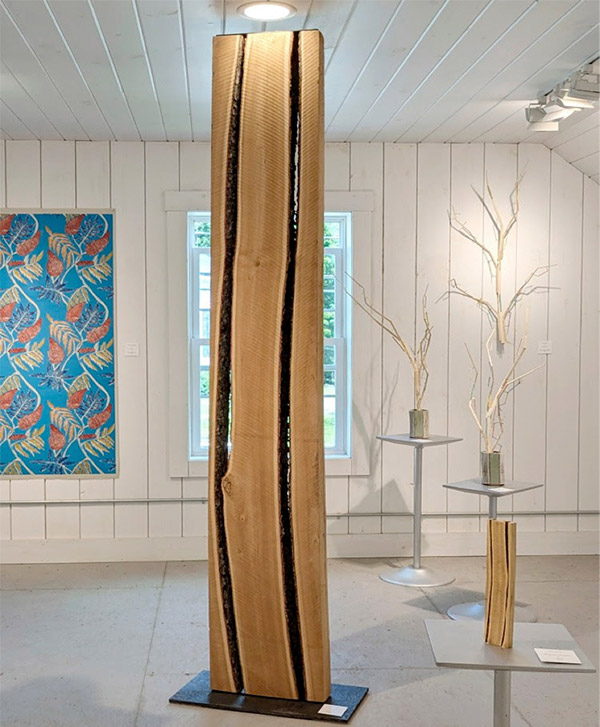
At the "imposing" end of the scale are Berenice Abbott's "Banyan Tree" of 1954 (a nice inclusion, considering the Abbott show down the street) and the sculpture by Monson Arts' educational coordinator James Pullen. The latter consists of planks shaved vertically from a tree, bark facing in and, facing out, the raw grained wood displaying the circular saw marks. It has a statuesque bearing in the gallery, its simplicity of form emanating a powerful presence while, simultaneously, its inside-out construction make it feel naked and vulnerable in a palpable way.
Behind it is a trio of Don Miller's wonderfully inventive "Ash Branch" sculptures, in which he has constructed branch-like forms from lengths of ash then "rooted" them in repurposed wood-slat "pots." Nails hammered shallowly into the branches support colorful rubber bands that give the impressions they are holding the branch forms together through tension. It's this sort of quirkiness along with Sam Margevicius's hilarious "Picnic Table Tableau" photo and a lidded ceramic vessel by the gallery's owner Jemma Gascoine that leans coquettishly to one side) that make the show delightful as well as substantial.
Jorge S. Arango has written about art, design and architecture for over 35 years. He lives in Portland. He can be reached at: jorge@jsarango.com
- IF YOU GO
- WHAT: "Tree Talk"
- WHERE: Monson Pottery/Gascoine Gallery, 16 Greenville Road, Monson
- WHEN: Through Dec. 31
- HOURS: 10 a.m. to 5 p.m. Wednesday-Saturday, or by appointment
- ADMISSION: Free
- INFO: jemmagascoine.com, 207-370-7099